Cyperaceae taxon details
Carex pachamamae Jim.Mejías & Reznicek
1676679 (urn:lsid:marinespecies.org:taxname:1676679)
accepted
Species
terrestrial
Jimenez-Mejías, P.; Reznicek, A. A. (2018). Additional notes on South American Carex sect. Schiedeanae (Cyperaceae) and description of the new species Carex pachamamae. <em>Phytotaxa.</em> 340(1): 55-62., available online at https://doi.org/10.11646/phytotaxa.340.1.3
page(s): 56 [details] Available for editors [request]
page(s): 56 [details] Available for editors
[request]
Holotype US 02140964, geounit Bolivia
Holotype US 02140964, geounit Bolivia [details]
Description Perennial, cespitose. Stems 21.2–48 cm long, 1.5–2.5 mm width in its middle length, ± as long as the leaves, with...
Etymology Dedicated to the Pachamama, goddess of Inca origin that personifies the Mother Earth, and that is widely revered by the...
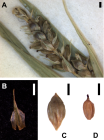
Description Perennial, cespitose. Stems 21.2–48 cm long, 1.5–2.5 mm width in its middle length, ± as long as the leaves, with narrowly winged margins, scabrid its entire length, with pickles in both antrorse and retrorse directions; basal sheaths up to 1.7 cm high, scale-like, brown, splitting into fibers. Leaves flattish, V-shaped towards the base, pale bluish-green, subcoriaceous, straight or slightly outcurved, adaxially papillose, 5–8 mm wide, the uppermost of the flowering stem with a blade up to 24 cm long, the midvein more prominent than the others abaxially, no veins more marked than the ohers adaxially, only the widest leaves sometimes with two lateral veins slightly more apparent than the others on the adaxial side; ligule rounded, the free margins reddish; old leaf remnants present at the base of the flowering steams, brown to straw-colored, decomposing in fibers. Inflorescence 2.7–4.3 cm long, with 3 androgynous spikes, lowest one ± concealed by the lowermost bract; lowermost bract 7–10.6 cm × 4.5–6 mm at its widest point, erect, much longer than its spike, the other bracts progressively smaller towards the apex, also erect, the uppermost one shorter than its spike and supporting a utricle. Spikes androgynous, densely flowered, with up to 20 utricles, the pistillate part much more developed than the staminate one; uppermost spike the longest, 18 × 5 mm, with a staminate part 3–4 × 0.8–1.5 mm; utriculiform cladoprophylls present at the base of the lower spikes, ± 2 mm long, reddish, with a beak with ciliate margins, apparently containing an aborted female flower. Staminate glumes 1–1.5 × 1 mm, obovate, obtuse, hyaline, the central nerve green, sometimes continued at the tip into a diminutive short scabrid mucro. Pistillate glumes persisting on the spike rachis after the utricle falls, with a body 1.6–2 × 1.2–1.5 mm, obovate, hyaline, with a central band greenish, with 1–3 nerves, continued into a differently developed mucro, the glumes from the lower part of each spike with a scabrid awn up to 2 mm those of the upper part with a diminutive 0.1 mm mucro. Utricles 2.7–3.3 × 1.2 1.7 mm, elliptic-fusiform, membranaceous, pale whitish-green or slightly reddish-tinged below, glabrous, nerveless, the faces concave, abruptly contracted into a smooth and shortly cylindric 0.2–0.3 mm long beak. Stigmas 3, very short, reddish-brown, densely papillose, conspicuously convolute backwards; style base bulbous, deciduous, leaving a flattish remnant at the top of the achene. Achene 2.2–2.3 × 1.2–1.5 mm, trigonous, the sides concave, more markedly proximally; rachilla absent; anthers ca. 0.6 mm long. [details]
Etymology Dedicated to the Pachamama, goddess of Inca origin that personifies the Mother Earth, and that is widely revered by the...
Etymology Dedicated to the Pachamama, goddess of Inca origin that personifies the Mother Earth, and that is widely revered by the people of the Andes. [details]
Cyperaceae Working Group. (2025). [see How to cite]. Global Cyperaceae Database. Carex pachamamae Jim.Mejías & Reznicek. Accessed at: https://www.cyperaceae.org/aphia.php?p=taxdetails&id=1676679 on 2026-09-23
Date
action
by
2024-12-10 11:47:54Z
unchecked
db_admin
 The webpage text is licensed under a Creative Commons
Attribution 4.0 License
Nomenclature
original description
Jimenez-Mejías, P.; Reznicek, A. A. (2018). Additional notes on South American Carex sect. Schiedeanae (Cyperaceae) and description of the new species Carex pachamamae. <em>Phytotaxa.</em> 340(1): 55-62., available online at https://doi.org/10.11646/phytotaxa.340.1.3
page(s): 56 [details] Available for editors [request]
page(s): 56 [details] Available for editors
[request]Taxonomy
taxonomy source
Jiménez-Mejías, P.; Fabbroni, M.; Haigh, A. (2020). Chorological, nomenclatural and taxonomic notes on Carex (Cyperaceae) from Bolivia and northern Argentina. <em>Kew Bulletin.</em> 75(1): 24., available online at https://doi.org/10.1007/s12225-020-9880-8
note: A Bolivian record of C. subandrogyna is assigned to C. pachamamae [details] Available for editors [request]
note: A Bolivian record of C. subandrogyna is assigned to C. pachamamae [details] Available for editors
[request]Other
additional source
Jiménez-Mejías, P.; García-Moro, P.; Camilo, A. A.; Mazzei, P. M.; Escudero, M.; Martín-Bravo, S.; Cano, A. (2026). A commented checklist and key for the genus <i>Carex</i> (Cyperaceae) in Peru. <em>PhytoKeys.</em> 271: 93-144., available online at https://doi.org/10.3897/phytokeys.271.178418
page(s): 114 [details]
page(s): 114 [details]
 Present Inaccurate Introduced: alien Containing type locality
Holotype US 02140964, geounit Bolivia [details]
From editor or global species database
Description Perennial, cespitose. Stems 21.2–48 cm long, 1.5–2.5 mm width in its middle length, ± as long as the leaves, with narrowly winged margins, scabrid its entire length, with pickles in both antrorse and retrorse directions; basal sheaths up to 1.7 cm high, scale-like, brown, splitting into fibers. Leaves flattish, V-shaped towards the base, pale bluish-green, subcoriaceous, straight or slightly outcurved, adaxially papillose, 5–8 mm wide, the uppermost of the flowering stem with a blade up to 24 cm long, the midvein more prominent than the others abaxially, no veins more marked than the ohers adaxially, only the widest leaves sometimes with two lateral veins slightly more apparent than the others on the adaxial side; ligule rounded, the free margins reddish; old leaf remnants present at the base of the flowering steams, brown to straw-colored, decomposing in fibers. Inflorescence 2.7–4.3 cm long, with 3 androgynous spikes, lowest one ± concealed by the lowermost bract; lowermost bract 7–10.6 cm × 4.5–6 mm at its widest point, erect, much longer than its spike, the other bracts progressively smaller towards the apex, also erect, the uppermost one shorter than its spike and supporting a utricle. Spikes androgynous, densely flowered, with up to 20 utricles, the pistillate part much more developed than the staminate one; uppermost spike the longest, 18 × 5 mm, with a staminate part 3–4 × 0.8–1.5 mm; utriculiform cladoprophylls present at the base of the lower spikes, ± 2 mm long, reddish, with a beak with ciliate margins, apparently containing an aborted female flower. Staminate glumes 1–1.5 × 1 mm, obovate, obtuse, hyaline, the central nerve green, sometimes continued at the tip into a diminutive short scabrid mucro. Pistillate glumes persisting on the spike rachis after the utricle falls, with a body 1.6–2 × 1.2–1.5 mm, obovate, hyaline, with a central band greenish, with 1–3 nerves, continued into a differently developed mucro, the glumes from the lower part of each spike with a scabrid awn up to 2 mm those of the upper part with a diminutive 0.1 mm mucro. Utricles 2.7–3.3 × 1.2 1.7 mm, elliptic-fusiform, membranaceous, pale whitish-green or slightly reddish-tinged below, glabrous, nerveless, the faces concave, abruptly contracted into a smooth and shortly cylindric 0.2–0.3 mm long beak. Stigmas 3, very short, reddish-brown, densely papillose, conspicuously convolute backwards; style base bulbous, deciduous, leaving a flattish remnant at the top of the achene. Achene 2.2–2.3 × 1.2–1.5 mm, trigonous, the sides concave, more markedly proximally; rachilla absent; anthers ca. 0.6 mm long. [details]Etymology Dedicated to the Pachamama, goddess of Inca origin that personifies the Mother Earth, and that is widely revered by the people of the Andes. [details]

To Biodiversity Heritage Library (1 publication)
To European Nucleotide Archive, ENA (Carex pachamamae)
To GenBank (2 nucleotides; 1 proteins)
To International Plant Names Index (IPNI)
To Plants of the World Online
To US Herbarium (Carex pachamamae US1178380 holotype 1)
To European Nucleotide Archive, ENA (Carex pachamamae)
To GenBank (2 nucleotides; 1 proteins)
To International Plant Names Index (IPNI)
To Plants of the World Online
To US Herbarium (Carex pachamamae US1178380 holotype 1)
From editor or global species database

Hosted externally