
Cyperaceae taxon details
Carex lepida Boott
1677499 (urn:lsid:marinespecies.org:taxname:1677499)
accepted
Species
terrestrial
Boott, F.; Castle; Maubert, M.; Rees; Hooker, J. D. (1867). Illustrations of the genus <i>Carex</i>. pt.4., available online at https://www.biodiversitylibrary.org/page/58671362
page(s): 211 [details]
page(s): 211 [details]
Type locality contained in Ecuador
type locality contained in Ecuador [details]
Description Perennial; rhizomes elongated. Stems 9–29 cm long, 0.4–0.8 mm width in its middle length, shorter than or as long as...
Description Perennial; rhizomes elongated. Stems 9–29 cm long, 0.4–0.8 mm width in its middle length, shorter than or as long as the leaves, trigonous, with narrowly winged margins; flowering shoots without basal sheaths, sterile ones with soft scale-like sheaths, brown or straw-colored. Leaves flat or slightly M shaped in cross section, apparently hypostomatic, the uppermost of the flowering stems with a blade 20–35 cm long, the widest with a blade 3.4–4.4 mm width; ligule 3–3.7 mm, longer than wide, acute to subacute, reddish. Inflorescence 1.3–2.7 cm long, with 2–3 spikes, the uppermost androgynous or female, the other ones female, being the lowest one ± covered at the base by the lowermost bract; lowermost bract 1.8–10 cm × 1.1–3.6 mm, much longer than the inflorescence, sheathless; second lowermost bract 2.8–0.7 cm × 3.6–1.1 mm, longer than its spike. Spikes androgynous, or apparently all female in underdeveloped stems, sometimes the uppermost androgynous and the rest apparently female; uppermost spike the largest, 10.4–8.4 × 3–3.9 mm, with up to 12–16 utricles, when androgynous with the male part 1.1–1.7 mm long; lowermost spike 6.1–9.5 × 2.6–2.8 mm; cladoprophylls tubular. Male glumes hyaline, acute, crowded at the top of the androgynous spikes. Female glumes 1.2–1.5 × 0.4–1 mm, hyaline, obovate, with a central band greenish with 1 nerve, obtuse, mucronate, the ones from the middle part of the spike with the mucro 1–0.4 mm long. Utricle 2.5–3.1 × 1.2–1.6 mm, elliptical, soft, membranaceous, greenish, nerveless except for the two lateral nerves, attenuated into a 0.4–0.7 mm smooth beak. Stigmas 2, very short, conspicuously convolute backward, reddish-brown; style base bulbous, deciduous, apparently not leaving remnant at the top of the achene. Achene 1.7 × 1.6 mm, suborbicular, narrowly biconvex; rachilla present, conspicuous, shorter than the achene. [details]
Cyperaceae Working Group. (2025). [see How to cite]. Global Cyperaceae Database. Carex lepida Boott. Accessed at: https://www.cyperaceae.org/aphia.php?p=taxdetails&id=1677499 on 2026-09-29
Date
action
by
2024-12-10 11:47:54Z
unchecked
db_admin
 The webpage text is licensed under a Creative Commons
Attribution 4.0 License
Nomenclature
original description
Boott, F.; Castle; Maubert, M.; Rees; Hooker, J. D. (1867). Illustrations of the genus <i>Carex</i>. pt.4., available online at https://www.biodiversitylibrary.org/page/58671362
page(s): 211 [details]
page(s): 211 [details]
Taxonomy
taxonomy source
Jiménez-Mejías, P.; Escudero, M. (2016). Notes on South American <i>Carex</i> section <i>Schiedeanae</i> and description of the new species <i>Carex roalsoniana</i>. <em>Phytotaxa.</em> 260(2): 185-192., available online at https://doi.org/10.11646/phytotaxa.260.2.8 [details] Available for editors  [request]
taxonomy source Jiménez-Mejías, P.; García-Moro, P.; Tiburcio, R. M. G.; Cano, A.; Martín-Bravo, S. (2023). New relevant chorological data on sedges (Cyperaceae) of Peru. <em>Kew Bulletin.</em> 78(4): 539-545., available online at https://doi.org/10.1007/s12225-023-10095-y [details] Available for editors [request]
taxonomy source Jimenez-Mejías, P.; Reznicek, A. A. (2018). Additional notes on South American Carex sect. Schiedeanae (Cyperaceae) and description of the new species Carex pachamamae. <em>Phytotaxa.</em> 340(1): 55-62., available online at https://doi.org/10.11646/phytotaxa.340.1.3 [details] Available for editors [request]
[request]taxonomy source Jiménez-Mejías, P.; García-Moro, P.; Tiburcio, R. M. G.; Cano, A.; Martín-Bravo, S. (2023). New relevant chorological data on sedges (Cyperaceae) of Peru. <em>Kew Bulletin.</em> 78(4): 539-545., available online at https://doi.org/10.1007/s12225-023-10095-y [details] Available for editors
[request]taxonomy source Jimenez-Mejías, P.; Reznicek, A. A. (2018). Additional notes on South American Carex sect. Schiedeanae (Cyperaceae) and description of the new species Carex pachamamae. <em>Phytotaxa.</em> 340(1): 55-62., available online at https://doi.org/10.11646/phytotaxa.340.1.3 [details] Available for editors
[request]Other
additional source
Jiménez-Mejías, P.; García-Moro, P.; Camilo, A. A.; Mazzei, P. M.; Escudero, M.; Martín-Bravo, S.; Cano, A. (2026). A commented checklist and key for the genus <i>Carex</i> (Cyperaceae) in Peru. <em>PhytoKeys.</em> 271: 93-144., available online at https://doi.org/10.3897/phytokeys.271.178418
page(s): 114 [details]
subsequent type designation Jiménez-Mejías, P.; Escudero, M. (2016). Notes on South American <i>Carex</i> section <i>Schiedeanae</i> and description of the new species <i>Carex roalsoniana</i>. <em>Phytotaxa.</em> 260(2): 185-192., available online at https://doi.org/10.11646/phytotaxa.260.2.8 [details] Available for editors [request]
page(s): 114 [details]
subsequent type designation Jiménez-Mejías, P.; Escudero, M. (2016). Notes on South American <i>Carex</i> section <i>Schiedeanae</i> and description of the new species <i>Carex roalsoniana</i>. <em>Phytotaxa.</em> 260(2): 185-192., available online at https://doi.org/10.11646/phytotaxa.260.2.8 [details] Available for editors
[request] Present Inaccurate Introduced: alien Containing type locality
Isolectotype G 00098282, geounit Ecuador [details]
From editor or global species database
Description Perennial; rhizomes elongated. Stems 9–29 cm long, 0.4–0.8 mm width in its middle length, shorter than or as long as the leaves, trigonous, with narrowly winged margins; flowering shoots without basal sheaths, sterile ones with soft scale-like sheaths, brown or straw-colored. Leaves flat or slightly M shaped in cross section, apparently hypostomatic, the uppermost of the flowering stems with a blade 20–35 cm long, the widest with a blade 3.4–4.4 mm width; ligule 3–3.7 mm, longer than wide, acute to subacute, reddish. Inflorescence 1.3–2.7 cm long, with 2–3 spikes, the uppermost androgynous or female, the other ones female, being the lowest one ± covered at the base by the lowermost bract; lowermost bract 1.8–10 cm × 1.1–3.6 mm, much longer than the inflorescence, sheathless; second lowermost bract 2.8–0.7 cm × 3.6–1.1 mm, longer than its spike. Spikes androgynous, or apparently all female in underdeveloped stems, sometimes the uppermost androgynous and the rest apparently female; uppermost spike the largest, 10.4–8.4 × 3–3.9 mm, with up to 12–16 utricles, when androgynous with the male part 1.1–1.7 mm long; lowermost spike 6.1–9.5 × 2.6–2.8 mm; cladoprophylls tubular. Male glumes hyaline, acute, crowded at the top of the androgynous spikes. Female glumes 1.2–1.5 × 0.4–1 mm, hyaline, obovate, with a central band greenish with 1 nerve, obtuse, mucronate, the ones from the middle part of the spike with the mucro 1–0.4 mm long. Utricle 2.5–3.1 × 1.2–1.6 mm, elliptical, soft, membranaceous, greenish, nerveless except for the two lateral nerves, attenuated into a 0.4–0.7 mm smooth beak. Stigmas 2, very short, conspicuously convolute backward, reddish-brown; style base bulbous, deciduous, apparently not leaving remnant at the top of the achene. Achene 1.7 × 1.6 mm, suborbicular, narrowly biconvex; rachilla present, conspicuous, shorter than the achene. [details]Etymology note Apparently from the Latin lepidus –a –um, which translates for “gracious”. [details]

To Biodiversity Heritage Library (6 publications)
To European Nucleotide Archive, ENA (Carex lepida)
To GenBank (5 nucleotides; 2 proteins)
To Genève Herbarium (Carex lepida G00098282 isolectotype 1)
To International Plant Names Index (IPNI)
To IUCN Red List (Critically Endangered)
To Plants of the World Online
To Royal Botanic Garden Edinburgh Herbarium (Carex lepida E00502222 isolectotype 1)
From editor or global species database
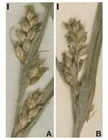
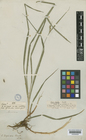

Hosted externally

Hosted externally