Cyperaceae name details
Schoenoplectiella cuddalorensis Soosairaj
1905572 (urn:lsid:marinespecies.org:taxname:1905572)
unaccepted > heterotypic synonym
Species
recent only
Lincy, J.; Soosairaj, S.; Raja, H. D. (2026). <i>Schoenoplectiella cuddalorensis</i> Soosairaj sp. nov. (Cyperaceae), from scrub vegetation of Tamil Nadu, India. <em>Feddes Repertorium.</em> 137(3): e70149., available online at https://doi.org/10.1002/fedr.70149
page(s): 2 [details] Available for editors [request]
page(s): 2 [details] Available for editors
[request]
Holotype RHT, geounit Tamil Nadu
Holotype RHT, geounit Tamil Nadu [details]
Description Culms sparsely tufted, rhizomatous, annuals, slender, terete, 12–27 cm high, smooth. Leaves the basal one reduced to...
Etymology The specific epithet refers to Cuddalore District, from where the type specimen was collected.
Taxonomic remark The original description (Lincy, 2026) of this taxon includes a close-up image of the fruit's surface, in which roughly...
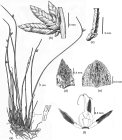
Description Culms sparsely tufted, rhizomatous, annuals, slender, terete, 12–27 cm high, smooth. Leaves the basal one reduced to bladeless sheath with mucronate apex, dark brown, the apical one well developed, linear, folded, 3.5–6.5 × 0.2 cm, sheath green, tubular with truncate mouth, 2–3 cm long, ligule 0. Inflorescence pseudolateral, capitate. Involucral bracts 1 or 2; lower bract erect, shorter than culm, 1.5–4 cm long, continuous to culm, culm-like, canaliculate, apex acute; upper bract short, 0.5–1 cm long, glabrous, canaliculate. Spikelets 1–7 in a cluster, ovate–oblong, 4–9 × 1–1.5 mm, many flowered, stramineous; rachilla winged. Glumes spirally arranged, broadly ovate, apex acute, 1.5 × 2 mm, concave, keeled, margin hyaline. Perianth bristles and hypogynous scales absent. Stamens 3, filaments up to 1.2 mm long, anthers linear, c. 0.8 mm long, apex acute. Ovary obovoid, 0.5 mm long. Style 1 mm long, glabrous, stigmas 2, 0.5 mm long. Nutlets oblongoid, plano-convex, 1.1–1.2 × 0.4–0.6 mm, apiculate, golden yellow, reticulate. [details]
Etymology The specific epithet refers to Cuddalore District, from where the type specimen was collected.
Etymology The specific epithet refers to Cuddalore District, from where the type specimen was collected. [details]
Taxonomic remark The original description (Lincy, 2026) of this taxon includes a close-up image of the fruit's surface, in which roughly...
Taxonomic remark The original description (Lincy, 2026) of this taxon includes a close-up image of the fruit's surface, in which roughly isodiametric epidermal cells can be observed. However, the fruit epidermal cells of Schoenoplectiella are linear with a minimum reported length to width ratio of 8.00 (see Starr et al., 2021). This suggested that the taxon does not belong in Schoenoplectiella (Bradshaw 2026, pers. obs.).
After a careful examination of the description and plate, we have concluded that Cyperus laevigatus L. (s.s.) is a match for this taxon (Larridon & Jiménez-Mejías 2026; pers. obs.). [details]
After a careful examination of the description and plate, we have concluded that Cyperus laevigatus L. (s.s.) is a match for this taxon (Larridon & Jiménez-Mejías 2026; pers. obs.). [details]
Cyperaceae Working Group. (2026). [see How to cite]. Global Cyperaceae Database. Schoenoplectiella cuddalorensis Soosairaj. Accessed at: https://www.cyperaceae.org/aphia.php?p=taxdetails&id=1905572 on 2026-10-06
Date
action
by
 The webpage text is licensed under a Creative Commons
Attribution 4.0 License
Nomenclature
original description
Lincy, J.; Soosairaj, S.; Raja, H. D. (2026). <i>Schoenoplectiella cuddalorensis</i> Soosairaj sp. nov. (Cyperaceae), from scrub vegetation of Tamil Nadu, India. <em>Feddes Repertorium.</em> 137(3): e70149., available online at https://doi.org/10.1002/fedr.70149
page(s): 2 [details] Available for editors [request]
page(s): 2 [details] Available for editors
[request] Present Inaccurate Introduced: alien Containing type locality
From editor or global species database
Description Culms sparsely tufted, rhizomatous, annuals, slender, terete, 12–27 cm high, smooth. Leaves the basal one reduced to bladeless sheath with mucronate apex, dark brown, the apical one well developed, linear, folded, 3.5–6.5 × 0.2 cm, sheath green, tubular with truncate mouth, 2–3 cm long, ligule 0. Inflorescence pseudolateral, capitate. Involucral bracts 1 or 2; lower bract erect, shorter than culm, 1.5–4 cm long, continuous to culm, culm-like, canaliculate, apex acute; upper bract short, 0.5–1 cm long, glabrous, canaliculate. Spikelets 1–7 in a cluster, ovate–oblong, 4–9 × 1–1.5 mm, many flowered, stramineous; rachilla winged. Glumes spirally arranged, broadly ovate, apex acute, 1.5 × 2 mm, concave, keeled, margin hyaline. Perianth bristles and hypogynous scales absent. Stamens 3, filaments up to 1.2 mm long, anthers linear, c. 0.8 mm long, apex acute. Ovary obovoid, 0.5 mm long. Style 1 mm long, glabrous, stigmas 2, 0.5 mm long. Nutlets oblongoid, plano-convex, 1.1–1.2 × 0.4–0.6 mm, apiculate, golden yellow, reticulate. [details]Diagnosis Schoenoplectiella cuddalorensis closely resembles S. erecta in culm size, number of stigmas, and general leaf sheath characteristics (Table 1). However, it can be clearly distinguished by several diagnostic features, including the absence of perianth bristles and ligule, a truncate (rather than oblique) sheath mouth, a sessile head inflorescence (as opposed to a pedunculate corymb), a winged rachilla (vs. wingless), and oblongoid nutlets (vs. ovoid). The new species also shares certain similarities with S. corymbosa, particularly the presence of a prominent rhizome and the absence of ligule and perianth bristles. Nevertheless, it differs markedly in having a sessile head inflorescence (vs. pedunculate anthela) and oblongoid, plano-convex nutlets (vs. obovoid, trigonous nutlets). [details]
Etymology The specific epithet refers to Cuddalore District, from where the type specimen was collected. [details]
Taxonomic remark The original description (Lincy, 2026) of this taxon includes a close-up image of the fruit's surface, in which roughly isodiametric epidermal cells can be observed. However, the fruit epidermal cells of Schoenoplectiella are linear with a minimum reported length to width ratio of 8.00 (see Starr et al., 2021). This suggested that the taxon does not belong in Schoenoplectiella (Bradshaw 2026, pers. obs.).
After a careful examination of the description and plate, we have concluded that Cyperus laevigatus L. (s.s.) is a match for this taxon (Larridon & Jiménez-Mejías 2026; pers. obs.). [details]
From editor or global species database